If you want an introduction to debugging ‘hard’ ASP.NET problems (with Windbg and Adplus), you should check out Johan’s blog. I noticed this via Tess’s blog (not updated that often but nonetheless a great debugging resource) which I mentioned last year. The debugging reading list that the article references has moved to here.
 admin
admin
Head First Object-Oriented Analysis and Design
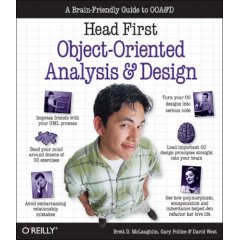
I found it hard to write a review about this book. Why? Because apart from a few, very minor typos it is simply superb! In my opinion, it is one of the best and sure to be one of the most influential books in this subject area. The O’Reilly Head First series of books are fast becoming the de facto standard, and I recommend that anyone who wants to get a deep understanding of how you should approach designing and developing software, read this book, no matter what your background or current skill set is. To date, I’ve read this book twice, cover to cover. It is not a particularly thin book, but it is very easy to read.
A colleague once told me that he picked up “Head First: Design Patterns” in a bookshop and flicked through it. He didn’t buy it because he wasn’t sure about the format, which if you’ve never seen a Head First book before, might at first seem a little different and perhaps off putting. As one reviewer put it:
“Hidden behind the funny pictures and crazy fonts is a serious, intelligent,
extremely well-crafted presentation of OO Analysis and Design. As I read the
book, I felt like I was looking over the shoulder of an expert designer who was
explaining to me what issues were important at each step and why.” — Edward Sciore
The book’s primary focus is “How to write great software”; this is summarised in 3 steps:
- Make sure your software does what the customer wants
- Apply basic OO principles to add flexibility
- Strive for a maintainable, reusable design.
It is a practical, readable and refreshing step-by-step walkthrough of the development process. It covers how to incorporate flexibility into all aspects of the software development life cycle. This book leads you through simple and then more advanced concepts by allowing you, the reader, to make the connections. In addition, it gives an easy to understand introduction to UML class diagrams.
Kathy Sierra talks about “Creating passionate users” over at the blog of the same name (highly recommended reading, as it is a gold mine of ideas and advice on creating great software). One of the beliefs espoused there is that it is better to get passionate responses from users at either end of the spectrum (i.e. love or hate it), rather than a mediocre “Yeah, it’s OK”. Judging by the polarised reviews over at Amazon, this book certainly creates passionate users/readers.
It is always hard to do justice to a great book in a short review, and this book is no exception. It is more readable and accessible than most other OO design books (excluding the other Head First design titles, of course!). I agree with Steve Bailey’s comments:
”I’d recommend this book to even the most veteran OO programmers. I put it up
there along with Code Complete …”
I would love to hear your thoughts on this book, so please leave a comment.
Careful with Those Bits, Eugene
I came across this roundup page of bit manipulations several years ago, and then prompty lost it.
So what are they good for? You’d be surprised where they crop up. Many a novel solution relies on these techniques. Admittedly, if all you are writing is UI presentation code, these probably won’t be of much use. On the other hand, if you ever take part in any ‘speed’ coding puzzles, there are deep low level techniques to be gleaned.
I’m posting a link so I can find it again!
(PS. Anyone recognise where my terrible title comes from?)
Regular Expression Resources
There are several tools that can assist with creating and testing regular expressions. The Regulator and Expresso are perhaps the most widely used.
The Regulator, written by Roy Osherove, features syntax highlighting and integrates with Regexlib.com’s database of online regular expressions via a web-service.
Expresso, written by Jim Hollenhorst, is another great tool for building and testing regular expressions. Expresso has some very nice features such as generating ready-to-paste C# code snippets from your regular expression.
Regex Workbench, written by Eric Gunnerson, has a nice feature that shows Tooltips that decode the meaning of subexpressions within an expression.
RegexDesigner written by Chris Sells is another useful tool. It is not quite as fully featured as some of the others.
Resources
- Regexlib: Regular Expression library: Regexlib also has a good resources section.
- Regular-Expression.info : has very clear explanations of various regular expression constructs, and some good examples.
- Learning .NET Regular Expressions with Expresso
- Introduction to Regular Expressions in .NET
- Regular Expressions in .NET by Darren Neimke.
- 4GuysFromRolla Regular Expression Information Roundup: includes links to introductory articles.
- Common Applications of Regular Expressions by Richard Lowe
Regular Expression Cheat Sheets
It might be a strange name for a technical site but www.ilovejackdaniels.com has a few gems of ‘cheat’ sheets (memory aid would be more accurate). The excellent regular expression sheet is no exception. In addition to the downloadable and printable cheat sheet this page gives one of the most understandable descriptions of regular expression functionality you will find anywhere.
There is a slightly less comprehensive but useful crib sheet here.
UPDATED: Add Regular-Expression.info to the resources list.
Interview Questions You Should Ask
On the whole, I’ve been fairly successful (or lucky) with interviews in my career. But I must admit that even though I’ve tended to be able to correctly answer most if not all of the interviewer’s questions, I don’t always ask them enough of the right questions. Asking the right questions is especially important if it’s your first developer position after finishing College/University, because the first few years could shape your career for the next ten. I mentioned the importance of this in a previous post, Software Development Must Haves.
The questions you forget to ask when you are interviewing for a job, but wish you had asked after taking the job by Bruce Eckel. It’s worth reading the range of extra questions that were posted in the comments section.
Top 10 Questions to Ask in an Interview, by Robin Ryan: This is a more general guide than just IT. I liked this quote: “An HR Director for Microsoft added: ‘Frequently the candidate, ill-prepared, searches his mind for just anything to ask. That person appears dumb, or uninterested, causing me to question what kind of employee they’d be.’”
Microsoft used to be big on lateral thinking / puzzle type interview questions as described in the book “How would you move Mount Fuji” by William Poundstone. Many of these are example of the “back of the envelope” technique (estimating from imprecise or missing information) which seems to be less frequently taught and practiced, such as “How many Piano Tuners are there in the U.S”. I’m not sure that these types of questions have ever been particularly relevant as interview questions (since the answers can be rote learned) but they can be amusing and good one-off, lateral thinking exercises: http://www.softwareinterview.com/
The Guerrilla Guide to Interviewing (version 3.0) by Joel Spolsky. Joel admits that he is fairly hard nosed about the interviewing process, “It’s because it is much, much better to reject a good candidate than to accept a bad candidate.” Joel suggests that only 2 things matter in a candidate: “In principle, it’s simple. You’re looking for people who are (1) Smart, and (2) Get things done.” I like Joel’s reference to the ‘hard part’ where he asks questions about recursion and pointers: “Sadly, despite the fact that I think that all good programmers should be able to handle recursion and pointers, and that this is an excellent way to tell if someone is a good programmer, the truth is that these days, programming languages have almost completely made that specific art unnecessary.” Whilst tutoring first year University students, I remember this was the ‘plateau’ that they had to get over in order to progress to the next level.
Scott Hanselman (and his clone army, ahem!) originally posted this list of questions aimed at ASP.NET developers. After a barrage of comments, he followed up with What Great .NET Developers Ought to Know, which resulted in a wide spectrum of responses ranging from people saying it was just a list of trivia, to those who basically thought “Ya, those are good. I’d probably have to look a few up.” If you can answer every single question correctly without looking anything up then you’re doing OK! Scott makes the point that he isn’t trying to reduce an interview to a set of trivia questions, and Joel Spolsky doen’t like these type of questions at all: “Remember, smart does not mean ‘knows the answer to trivia questions.’”
Interviewing Web Developers – 20 Good Questions to Ask: one of two of these questions are probably more useful than others.
To end this post, here is a little light programmer relief (or how to gather requirements): Stupid Interview Questions.
And how could I forget the Daily WTF (you have to read these!): Tales from the Interview, Security by Insanity (this is my all time favorite), Tales From The Interview: A Perfect Ten, The Abstract Candidate
Proudly Serving My Corporate Masters (Book Review)

I’ve just finished reading “Proudly Serving my Corporate Masters: What I learned in Ten Years as a Microsoft programmer” by Adam Barr. I saw this book mentioned on Joel Spolsky’s site (at least I think that’s where I saw it), and being an avid Microsoft watcher I just had to read it. It’s essentially a historical recount of the early to middle era of personal computing and the rise of the PC, interwoven with Adam’s ten years at Microsoft (1990 – 2000). It gives a fascinating insight into the work culture at Microsoft; some of Adam’s interviewer stories are excellent.
I found some parts of the book extremely interesting, others not so, possibly because they explain things obvious to a developer. If you read this along side other accounts (such as “Microsoft Secrets” by Cusumano and Selby), there seems to be something missing, something I couldn’t quite put my finger on. The prose does not always flow smoothly, but despite this it is was worth reading, especially if you’re forty-something and still remember 4.77MHz CPUs, the Z80, Amigas, CP/M and those rather large floppies… One thing this book does well, is to put into perspective how easy and pervasive internet access has become compared to the pre-internet, BBS days.
As an aside, Adam rejoined Micosoft in 2003, and as far as I know he is still there. You can read his blog here.
.NET Framework Design Guidelines (Book Review)
I believe that good technical books fall roughly into 3 categories:
- Required reading now but throwaway later: these books go out of date quickly (for instance, that thick copy of plain ASP 3.0, which is now almost completely useless!)
- Essential, technology agnostic, lifespan of more than 10 years: containing advice which applies across the board regardless of technology, language or version. These are often process related books. Examples of books in this category are “Code Complete”, and the excellent, recently released “Head First OO A & D” (review to follow shortly).
- Essential, technology specific, lifespan hard to measure due to possibility of rapid technology shifts: vital books targeted at some specific technology or language.
The Framework Design Guidelines by Brad Abrams and Krzysztof Cwalina falls mainly into the last category, but also overlaps somewhat with the second.

Who should read this book?
Architects, API and Framework designers, lead developers, junior developers who want to be senior developers(!). Basically, anyone who is designing frameworks or writing code targeting the .NET framework.
The book is divided into 9 chapters and 3 appendices. The guidelines are presented in 4 major forms: Do, Consider, Avoid and Do Not. The authors choose a single language for the examples (which are in C#), which rather being a snub to VB.NET developers is rather more of a complement, as they mention they wanted the book to appeal to the widest audience. A DVD is also included containing several hours of video presentations.
This book represents the condensed wisdom and best practices of literally hundreds of developers, and a number of well known and respected, industry heavyweights have annotated the book, providing discussion and reasoning behind the guidelines.
1. Introduction
This chapter is a brief introduction and discusses the qualities of a well designed framework and the philosophy behind the design. In summary, frameworks are: simple, expensive, full of trade-offs, borrow from previous designs, are designed to evolve, are integrated and last but not least, are consistent.
2. Framework Design Fundamentals
Offers principles and guidelines central to framework design. Talks about scenario-driven design (very similar to TDD), having a low barrier to entry, self documenting wherever possible, the principle of layered architecture, API usability studies.
3. Naming Guidelines
Consistent and accurate naming is an essential principle of designing and writing all code. Krzysztof writes: “The team that develops the .NET Framework Base Class Library spends an enormous amount of time on naming, and considers it to be a crucial part of framework development.” As a consultant, poor method naming is something I see often. As Steven Clarke notes, methods should be named according to what they do, not according to some implementation detail.
4. Type Design Guidelines
This chapter provides general guidelines for the design of types and covers some of the associated subtleties and tradeoffs. This is a heavily annotated chapter, brimming with excellent advice.
5. Member Design
This is one of the slightly longer chapters (57 pages), and follows on from chapter 4, covering basic guidelines that should be followed when designing members of any type. It covers the design of properties, constructors, events, fields, operator overloads, and parameters. I seem to learn something new each time I re-read this and the preceding chapter.
6. Designing for Extensibility
How do you ensure that your framework will be extensible and stand the test of time? This chapter covers unsealed classes, protected members, events and callbacks, virtual members and abstractions. The annotations in this chapter contain several gems of advice, including determining the trade off of extensibility versus performance and some of the subtleties of creating types with virtual members.
7. Exceptions
This chapter is surely the definitive reference for exception handling. It covers the reasoning and benefits behind using exceptions and the best practices in creating and using them within frameworks. Required reading for all developers. [David M Kean posted excellent advice on which exceptions to raise here.]
8. Usage Guidelines
This chapter covers guidelines for the use of common types in publicly accessible APIs, implementing common interfaces and extending common base classes.
9. Common Design Patterns
Chapter 9 does not cover the subject of design patterns in general; rather it discusses a limited set of patterns that are frequently used in the .NET framework.
Conclusion
There is little doubt that a few paragraphs can adequately capture what is contained in the Framework Design Guidelines, or the amount of cumulative effort that has gone into producing this distilled wisdom. If you are a serious .NET developer then you should definitely have access to a copy of this must-read book.
My favourite quotes from the book:
“I have always felt that a key characteristic of a framework must be consistency”, Anders Hejlsberg in the foreword.
“Frameworks must be designed starting from a set of usage scenarios and code samples implementing these scenarios.”
Writing Quality Code – Free e-Book
Dave Glover posted a heads-up on this great, free e-book written by some our local Aussie talent, Dr Neil Roodyn, Nick Weinholt, Rocky Heckman, Mitch Denny, Paul Glavich and Adam Cogan. You can download it from here (and the dnl reader from here) .
When to Throw Specific Exceptions
David M Kean has posted excellent guidelines on what specific exceptions should be thrown from within your .NET code. For an overview, see my post here.
VS2005 Cheat Sheets
A few months ago I posted Visual Studio 2005 IDE Productivity Tips and Tricks, and I just noticed that Rob Caron posted about these very handy VS2005 Cheat Sheets which can be downloaded from Microsoft.